Tattoo Removal on Dark Skin: Risks, Healing, and What Specialists See
Tattoo removal on dark skin: risks, healing factors, and what experienced clinics recommend.
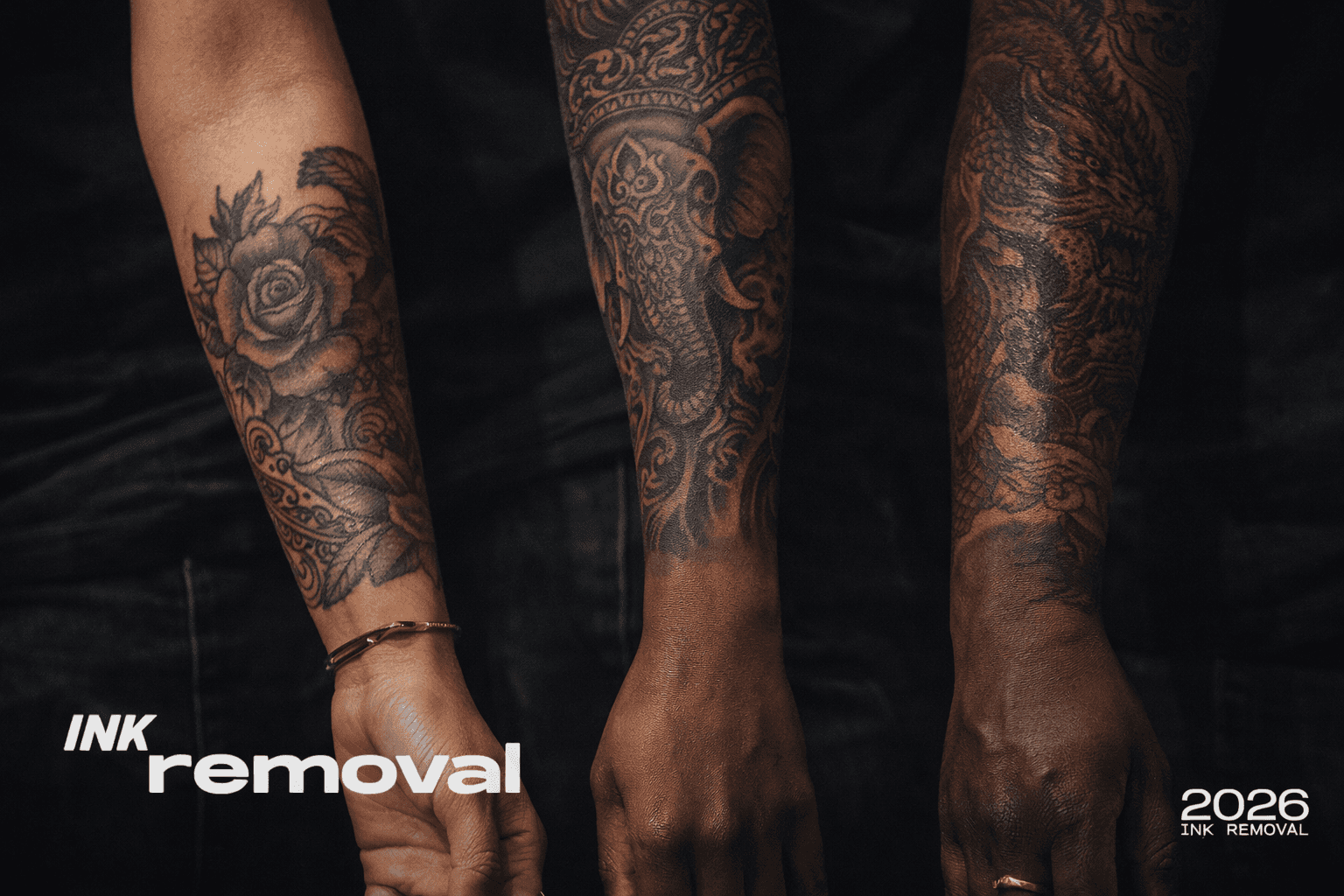
If you’ve spent any time researching tattoo removal, you’ve probably noticed two things:
Everyone says “it depends.”
Almost no one explains what it actually depends on in a way that feels grounded in real life.
That’s where we try to be useful.
Key takeaways: Skin type & removal
Risk, Not Results: Darker skin tones (Fitzpatrick IV-VI) aren't "harder" to treat, but they require a more conservative approach to protect natural pigment.
The Red Ink Rule: Red ink carries a higher risk of pigment change on darker skin because the laser wavelength used for red is also highly attracted to melanin.
Patience is Physiological: Tattoo removal is a biological process. Your lymphatic system needs 8–12 weeks to clear shattered ink; rushing sessions increases the risk of scarring without speeding up the fading.
Expect the Unexpected: Even with the same skin type, healing is individual. Test spots and adjusted protocols based on "real-time" healing are more important than any standard chart.
Ink Removal isn’t a clinic. We’re not here to tell you what will happen to your skin, or what choice you should make. We’re here to translate what people with similar skin types, tattoos, and timelines have actually experienced - and to flag where outcomes tend to vary.
To do that, we spoke with three laser clinics in very different parts of the U.S.:
Bonsai Tattoo Removal (Dallas, Texas) - Daniel J. Broome, certified laser specialist
Tampa Bay Tattoo Removal (Clearwater, Florida) - Nicholas Nizer IV and Anna Nizer, both certified laser specialists
Ink Free Tattoo Removal (Dover, New Hampshire) - led by Tim and Sarah Gonsalves, both certified laser specialists
They work in different climates, see different skin profiles, and adjust protocols accordingly. That matters. Sun exposure, humidity, and healing conditions aren’t abstract variables - they show up on real skin, between real sessions.
What follows isn’t a universal rulebook. It’s a set of experienced observations, placed next to what dermatology sources generally agree on - so you can decide what feels relevant to your situation.
Tattoo removal for dark skin: Does the process change?
The physics of the laser remain the same, but the safety protocols change significantly to protect natural skin pigment. In short:
The laser physics don’t change - but the risk profile does.
What Bonsai Tattoo Removal sees in practice
Bonsai Tattoo Removal works with a wide range of skin tones and relies heavily on the Fitzpatrick scale to assess risk, not outcomes.
He’s seen that skin with more melanin carries a higher risk of hypopigmentation (skin lightening), while lighter skin can still experience hyperpigmentation (darkening), usually temporarily.
For clients with Fitzpatrick skin types V-VI, Bonsai Tattoo Removal typically:
Spaces sessions further apart
Uses lower laser energy
Prioritizes long-term skin health over speed
Black ink often responds well even at lower settings. Other colors - especially red - can be much harder to treat safely on darker skin. In some cases, Bonsai Tattoo Removal has advised against removing red ink entirely if the risk of permanent skin change feels too high.
That’s not a universal rule. It’s a judgment call based on their experience, that skin, and that tattoo.
“We’re always weighing removal against long-term outcome. Sometimes the safest advice is not to push it.”
Why is red ink such a "proceed with caution" sign for darker skin? It comes down to wavelength targets. Black ink is typically treated with a 1064nm wavelength, which passes through melanin relatively safely. Red ink, however, requires a 532nm wavelength.
The problem? This wavelength is a "melanin magnet." It can’t easily distinguish between the red ink you want to remove and the natural pigment you want to keep. This is why specialists like the team at Bonsai Tattoo Removal often opt for lower energy or longer gaps—they’re trying to trick the laser into hitting the ink without "seeing" the skin’s natural color.
How that compares to “textbook” guidance
Dermatology sources generally say the same thing in more clinical language: higher melanin = higher risk of pigment changes, which can often be managed with conservative settings and spacing.
Where clinics differ is how cautious they are, and which risks they’re willing to accept. That’s not something a chart can decide for you.
Hyperpigmentation & hypopigmentation risks: Does skin type cause pigment changes?
Yes, though the type of change usually depends on your Fitzpatrick skin level.
Bonsai Tattoo Removal’s experience
The Bonsai Tattoo Removal team tends to see hypopigmentation as the bigger concern for more melanated skin types. Lighter skin types often tolerate treatment well but can still experience temporary hyperpigmentation.
What they’re careful not to do is over-generalize.
“You can have two people with the same Fitzpatrick type and totally different reactions.”
Because of that variability, Bonsai Tattoo Removal tracks laser settings closely and adjusts protocols based on how the skin actually heals, not how it’s “supposed” to heal.
What other clinics report
Tampa Bay Tattoo Removal has seen temporary hypopigmentation in darker skin types that often resolves within 3-6 months with proper spacing and aftercare.
Ink Free Tattoo Removal notes that both hyperpigmentation and hypopigmentation can occur across all skin types, but darker skin is statistically more prone to both.
Medical context (without overreach)
Dermatology literature supports all of this - pigment changes are known risks of laser procedures and are often temporary, but not guaranteed to resolve. Sun exposure and aftercare matter more than people expect.
What’s missing from most “expert” articles is this part: how patient clinics are willing to be when pigment changes appear.
Sensitive skin and lasers: Is tattoo removal still safe?
Yes, sensitive skin is rarely a "dealbreaker," but it does require a "read, don’t force" approach. Sensitivity is one of those words that means different things to different people.
Bonsai Tattoo Removal’s take
In Daniel’s experience, many reactions people label as “sensitive skin” - redness, swelling, itchiness - are actually normal responses to laser treatment.
He focuses more on:
Fitzpatrick skin type
Ink color
Reaction to test shots
He always starts with test spots and watches how the skin responds. Too much reaction -> dial it back. Too little -> adjust upward.
“We’re reading the skin, not forcing a plan.”
How that aligns with broader practice
Other clinics echoed this approach: sensitive skin doesn’t automatically disqualify someone from laser tattoo removal, but it does require more monitoring, longer spacing, and less aggressive settings.
Dermatology guidelines generally support test spots and conservative adjustments - but they don’t tell you how often clinics actually follow them. That’s where real-world experience matters.
Tattoo removal session spacing: What if I heal slowly?
If your skin heals slowly, your specialist will likely extend your wait time to 10–12 weeks or longer.
Across all clinics we spoke to
If healing is slow, sessions get pushed back. Often to 10-12 weeks or longer.
The team at Bonsai Tattoo Removal’s approach is simple:
“If the skin isn’t ready, we wait.”
Waiting isn’t a failure. It’s often what prevents scarring, pigment issues, or setbacks that cost more time later.
It’s a lymphatic game, not a laser game
It’s a common misconception that the laser "burns" the ink away. In reality, the laser acts like a sledgehammer, shattering a large boulder (the ink particle) into tiny pebbles.
Your lymphatic system—the body's internal drainage and filtration network—then has to do the heavy lifting of carrying those "pebbles" away. This process is slow. If you laser a site again before your white blood cells have finished clearing the debris from the last round, you aren’t speeding up the removal; you’re just stacking inflammation on top of inflammation. Pushing the session to 12 weeks gives your body the "clean-up time" it needs to actually show progress.
Total removal sessions: How much does skin type matter?
Skin type influences the pacing of your journey more than the total number of laser passes. Because more melanated skin requires lower energy and longer breaks, the "calendar time" to full removal is often longer, even if the session count is the same as a lighter-skinned patient.
Here’s where things get nuanced.
Ink Free notes darker skin may require more sessions because they start more conservatively.
Tampa Bay finds session count depends more on ink density, depth, color, and location.
Bonsai observes skin type influences pacing, not just session count. Lower energy + longer spacing can stretch timelines, even if the total number of sessions ends up similar.
The pattern we see
No one can tell you upfront exactly how many sessions you’ll need - and clinics that do are usually guessing.
What is predictable:
Slower pacing is common
Frustration is normal
Progress isn’t linear
Why we’re showing you all of this
We’re not trying to prove one clinic right or wrong.
We’re showing you how reasonable, experienced professionals can approach the same problem differently, based on skin type, climate, and risk tolerance - while still staying within what medical literature considers safe.
That doesn’t mean outcomes are random.
It means they’re contextual.
If there’s one thing we wish more people heard before starting tattoo removal, it’s this:
“Nothing is wrong with you if this takes longer than you expected.”
We’ll keep sharing what people like you are experiencing - not to promise outcomes, but to make the process feel less confusing and less lonely.
Now that we understand how skin type affects removal, the next question becomes more personal - what does it actually feel like?
——————————
Clinic Spotlight - Tampa Bay Tattoo Removal
Below is a brief background on one of the clinics featured in this series.
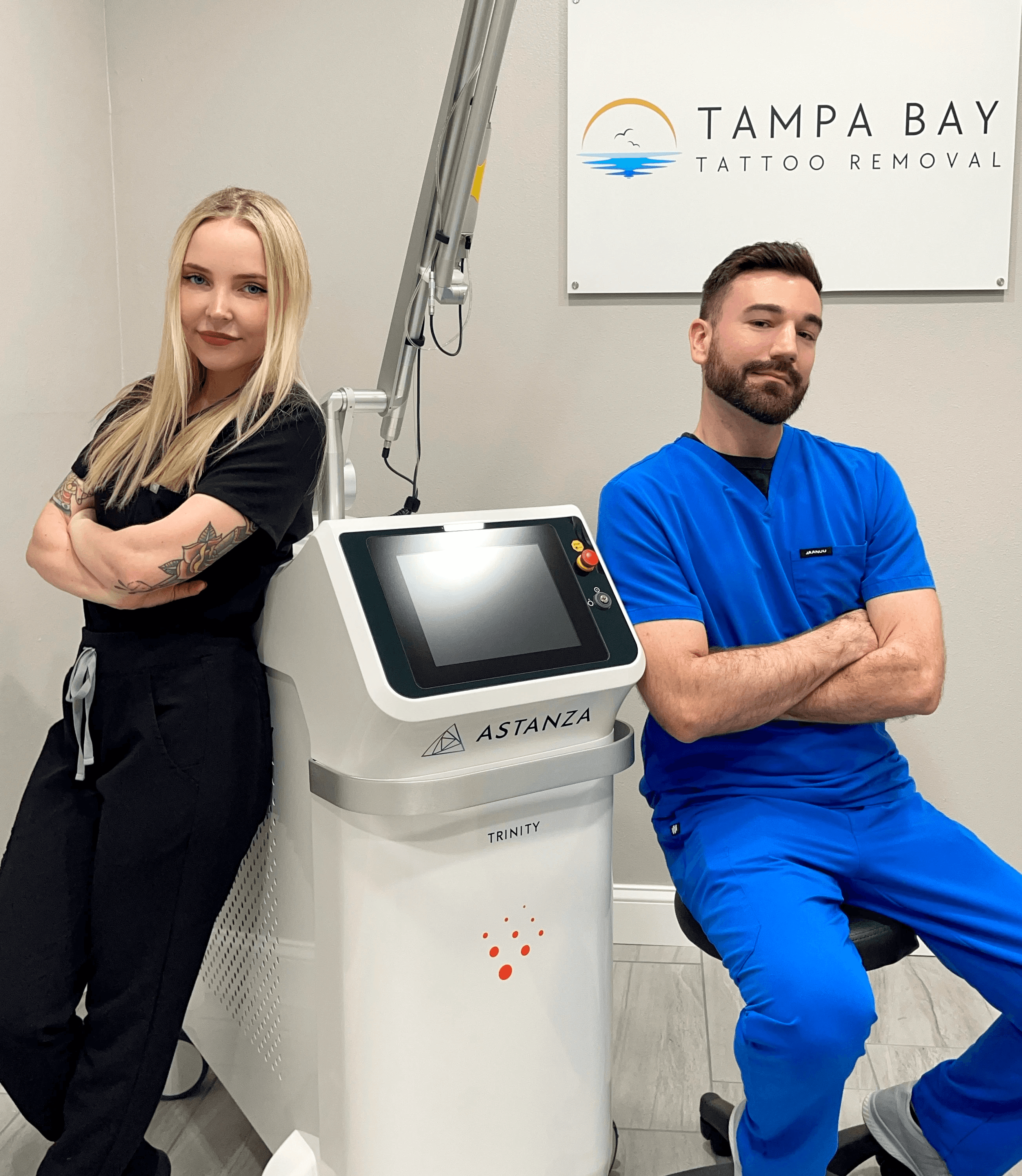
The name Tampa Bay Tattoo Removal was intentionally chosen to reflect both location and community reach. While the clinic is based in Clearwater, Florida - right next to Old Tampa Bay - the team regularly treats clients from Tampa, St. Petersburg, Sarasota, and surrounding areas. The goal was to create a name that felt straightforward, professional, and geographically inclusive.
The clinic is led by Nicholas Nizer IV, RN BSN CLS, a Registered Nurse and Certified Laser Specialist with over a decade in the medical industry. As a nurse led practice, the clinic emphasizes medical safety, proper laser protocol, and individualized treatment planning.
One of the most common surprises patients report is how fast sessions actually are. While tattoo removal is not typically described as comfortable, treatments are significantly quicker than the original tattoo process. Most sessions are completed in seconds to just a few minutes depending on size - something many clients find more manageable than expected.
Ink Removal isn’t a clinic. We’re not here to tell you what will happen to your skin, or what choice you should make. We’re here to translate what people with similar skin types, tattoos, and timelines have actually experienced - and to flag where outcomes tend to vary.
Nov 6, 2025
